
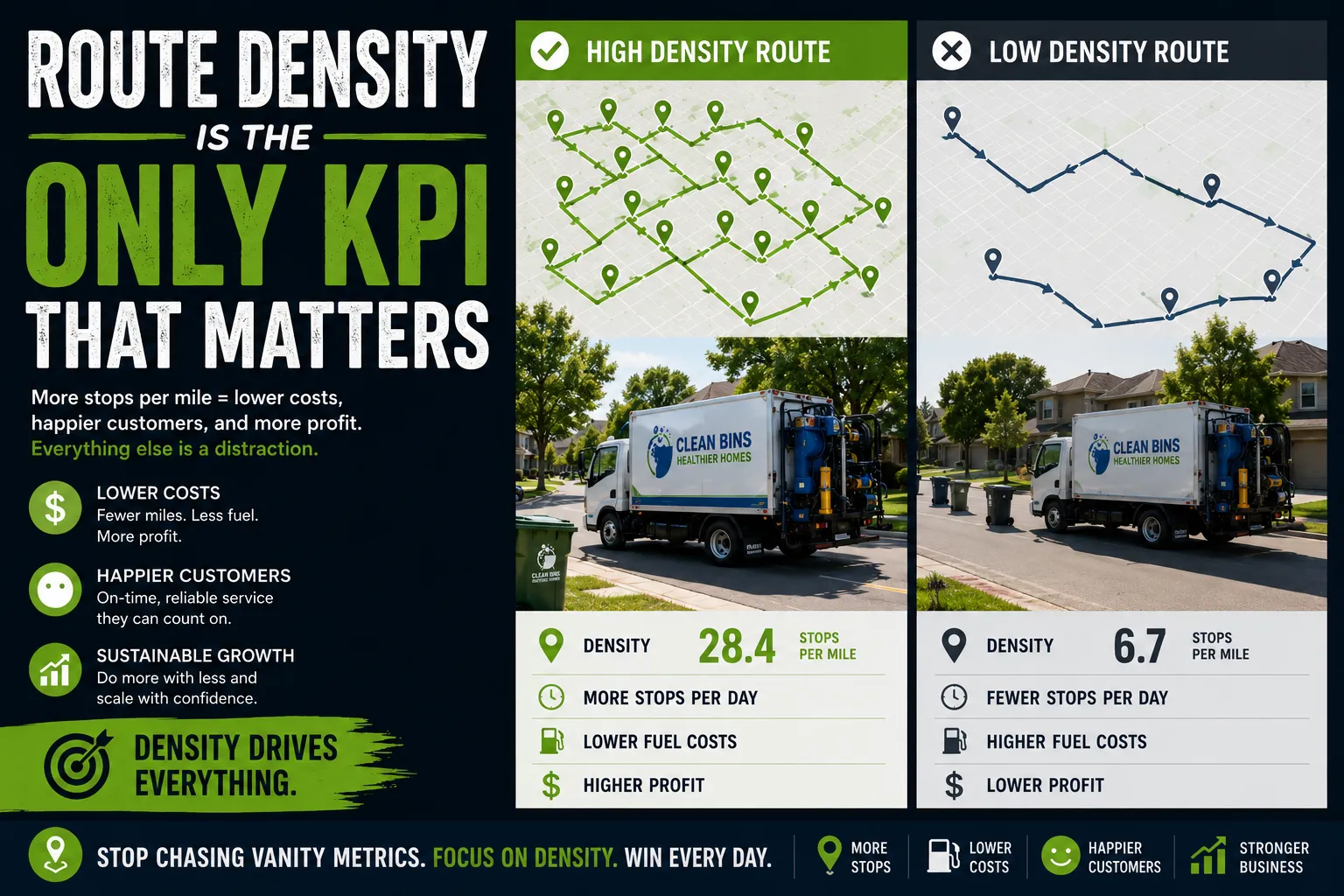
Two bin cleaners, same truck, same equipment, same town. One clears $400 on a Tuesday. The other clears $1,200. The difference isn’t price. It’s almost never price. It’s density.
The math
A productive route hour has two costs and one revenue:
- Drive time between stops (cost)
- Job time at each stop (cost — but it’s also where revenue happens)
- Revenue per stop (the only line item the customer sees)
If your average stop pays $22 and takes 5 minutes of job time, the only question that matters is: how much drive time per stop? Because every minute of drive time is a minute you can’t bill.
| Drive time / stop | Stops / 8hr day | Day revenue (@$22) |
|---|---|---|
| 3 min | 60 | $1,320 |
| 6 min | 44 | $968 |
| 10 min | 32 | $704 |
| 15 min | 24 | $528 |
That’s the same operator, same truck, same prices. The only thing that moved was drive time per stop.
Why density is hard
You don’t get density from one big customer. You get it from a hundred small customers on the same street. That means:
- Marketing has to be hyperlocal — flyers, neighborhood Facebook groups, a single subdivision newsletter — not city-wide ads.
- Pricing has to reward neighbors. “Same-street discount” is the cheapest marketing line you’ll ever write.
- Routing has to actually solve the route, not just list the stops in the order they were created.
How to grow density
The operators who scale past two trucks all did some version of this:
- Pick a beachhead. One subdivision, one school district. Saturate it.
- Refer-a-neighbor. $5 off for each, every month. Pays for itself in one missed drive minute.
- Same-day add-ons. When you’re already on a street, the marginal cost of one more bin is one minute. Charge $12, smile.
- Schedule by route, not by request. “Tuesday in Maple Ridge” trumps “whenever the customer asks.” Customers care less than you think.
What about the optimizer?
Optimizers help — a lot. We see 15–30% drive-time reductions on real routes once the solver gets a clean address list. But an optimizer can’t fix a sparse customer list. If your customers are 12 minutes apart, the best route in the world is still 12 minutes apart.
Density first. Optimization second. Pricing last.