
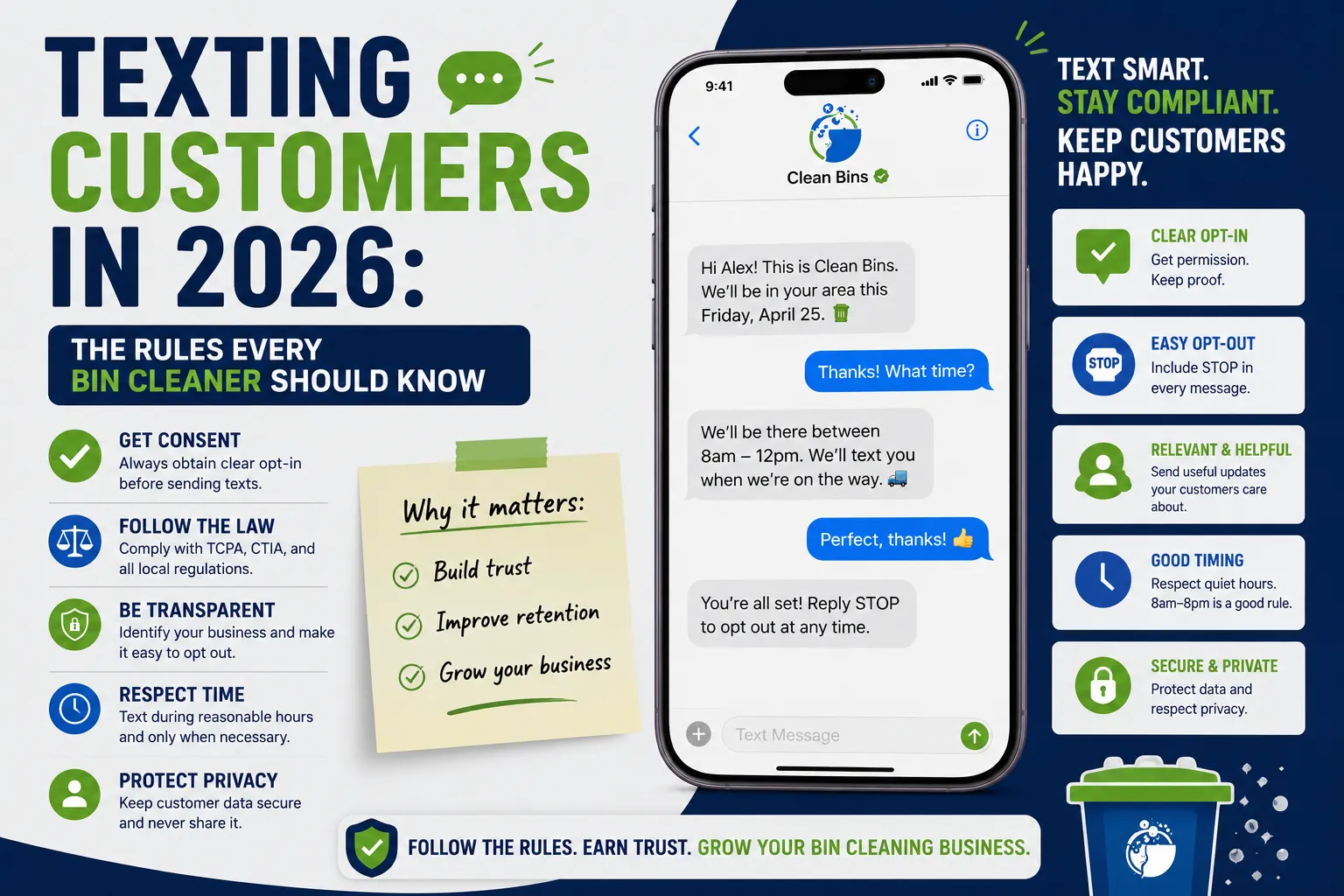
You can’t run a route business in 2026 without texting customers. Heads-up texts, on-the-way texts, photo proof, review asks — they’re table stakes. But the rules around business texting changed a lot in the last two years, and most operators only learn about them after a carrier blocks their number.
Here’s the short version, in plain English.
You need a real business number
Texting customers from your personal cell will get you blocked, fast. Carriers (AT&T, Verizon, T-Mobile) flag personal numbers sending high-volume business messages. You want a dedicated business number on a registered campaign — what the industry calls A2P 10DLC.
If you’re on BinBros, this is handled for you out of the box. If you’re not, your messaging provider should walk you through registering your brand and at least one campaign.
Consent is non-negotiable
The TCPA (and its state-level cousins like Florida’s FTSA) require prior express consent before you send marketing texts. For service-related texts (“we’ll be by tomorrow at 9am”), you generally need consent at the point of sign-up.
The simple rule: anywhere a customer gives you their cell number, put a checkbox or a line of text that says they agree to receive service and review texts from your business, with a way to opt out (STOP).
Opt-outs are the law
Every customer must be able to reply STOP at any time and have it work. You also need to honor UNSUBSCRIBE, CANCEL, END, QUIT, and a few others. Your software should record the opt-out timestamp.
If a customer opts out of one campaign, that doesn’t necessarily opt them out of every future communication — but the safest default is to honor it across the board.
Quiet hours
The federal default is 8am–9pm in the recipient’s local time zone. Several states are stricter. Don’t send 7am heads-ups, even if your truck rolls at 6am. Schedule the heads-up the night before.
Keep records
In a dispute, you need to be able to show:
- When and where the customer consented
- The exact text of the consent language
- The opt-out, if any, and when it was honored
You don’t need a lawyer for this. You need a system that records it automatically.
What happens if you ignore this?
Carriers block your number. Your texts silently fail to reach customers. You think you’re sending heads-ups; customers think you ghosted them. Worst case, a class-action firm takes interest — TCPA penalties run $500–$1,500 per text.
The good news: get the basics right and you’ll never think about any of this again. BinBros handles consent records, opt-outs, quiet hours, and 10DLC registration for every customer on the platform.